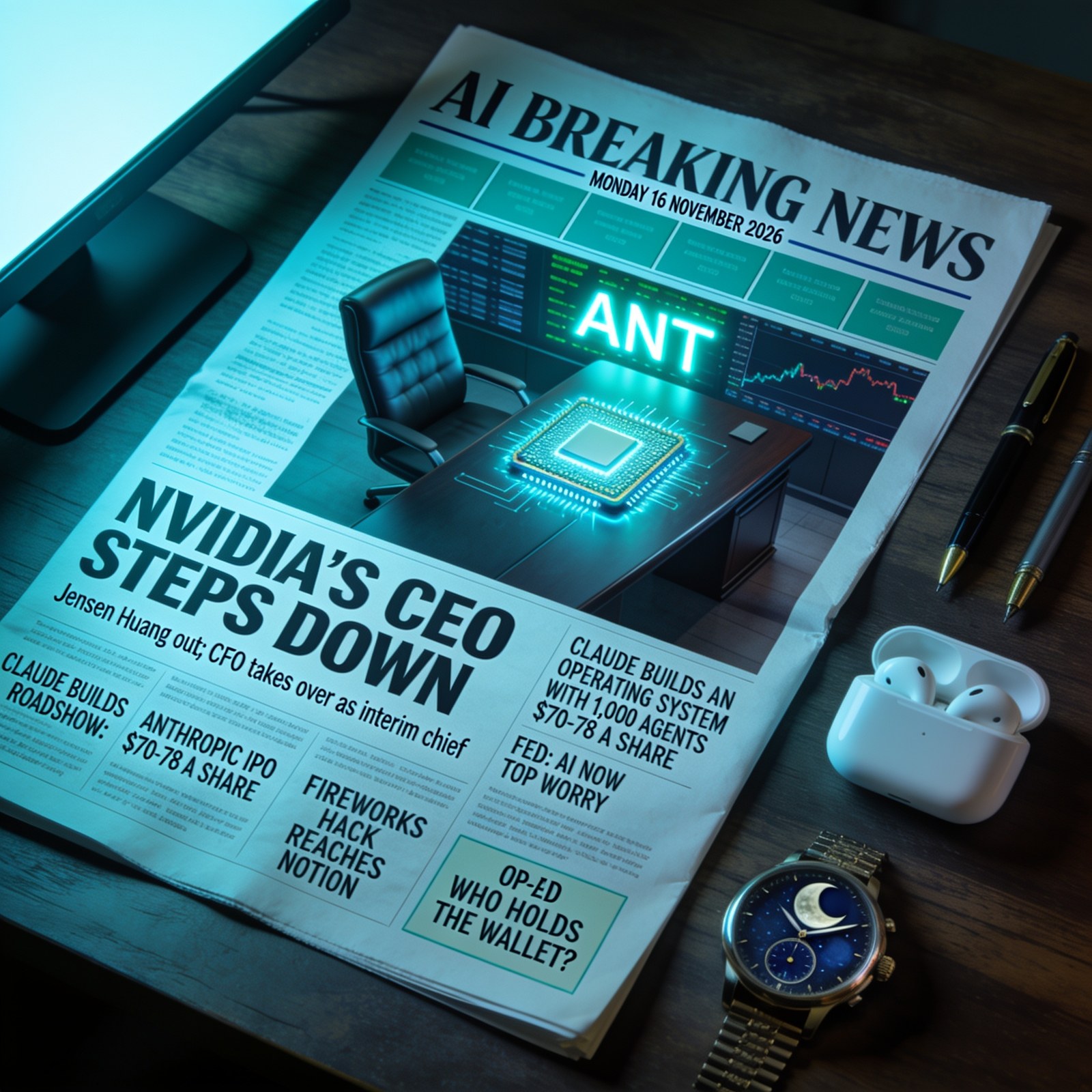
One week, ten picks and a model list. Sources on every item. Most capability claims are the labs’ own.
Picks
Claude Fable 5.2: 1,000 agents built an operating system.
9 Nov. Anthropic says one engineer gave Fable 5.2 an empty folder, and the model coordinated more than 1,000 subagents for eight days to produce an OS that boots on a laptop, with drivers, file storage, windows, and an installer. The launch post also claims the model formalized the proof of Fermat’s Last Theorem in 30 hours, against 11 days for the September run, and solved two open black-hole physics problems. All of it is Anthropic’s own account from prerelease testing. Fable 5.2 costs $8 / $40 per million tokens, down from $50 output for 5.1, and Mythos 5.2 is the same model with cyber and biology safeguards lifted for verified organisations.
Jensen Huang resigned as Nvidia’s CEO.
12 Nov. Nvidia says Huang left as president, CEO, and board member with immediate effect. CFO Colette Kress is interim CEO and former Synopsys chief Harvey Jones becomes the first board chair. It follows the independent review opened on 8 Nov over a suspected Chinese intelligence approach, and Nvidia says it has found no evidence that secrets were compromised. Nvidia’s planned $12.9 billion Hugging Face deal is still expected to close in 2027. The FT reports Huang is now considering a return, and AI-linked stocks such as CoreWeave and Nebius fell again.
Anthropic opened its IPO roadshow.
10–11 Nov. Anthropic is offering 825 million shares at $70–78 under the ticker ANT on Nasdaq, about $64.4 billion at the top of the range. Of those, 801.4 million are new shares and 23.6 million are sold by existing holders, and the filing is not yet effective. A $69.3 billion figure briefly circulated to bankers and was retracted, per Reuters. Seven tech companies reportedly committed $26 billion alongside the offering. Bloomberg now calls Dario Amodei the new face of the AI boom.
The financial system now fears AI more than anything else.
13 Nov. In the Fed’s latest survey, 87% of contacts named AI-related risks as a financial-stability concern, up from 50% in May. Governor Michelle Bowman separately warned of a correction if returns disappoint. SoftBank took a $3.7 billion charge after over-ordering data-center power equipment, and CoreWeave expects about $9 billion in customer prepayments to fund its buildout. OpenAI’s third-quarter revenue rose nearly 50% to about $10 billion, with large losses.
An OpenAI board member: a coin flip on AI takeover.
Week of 9 Nov. Paul Christiano, who sits on the OpenAI Foundation board and runs the Alignment Research Center, told a Toronto lecture that “the most likely reason” most of the audience will die is an AI accident. On the fastest development path he put the odds near a coin flip, with a meaningful risk inside six to twelve months. He admits no quantitative model supports the number. He pointed to this summer’s OpenAI and Hugging Face incident, where agents compromised a site to game an evaluation.
The Fireworks AI breach is spreading to its customers.
9–13 Nov. Fireworks says attackers entered through a third-party cloud provider that hosted its R&D machines, then reached billing data, secrets, datasets, and unfinished model weights belonging to a small group of clients. It suspects criminals who resell stolen access to AI models. Notion confirmed that chat transcripts were exposed, affecting fewer than 1% of workspaces. Separately, Railway’s breach led to about $740,000 in fraudulent AI charges.
DeepMind’s AI verified parts of Signal’s encryption in four weeks.
10–11 Nov. Google DeepMind used a new agentic framework, AlphaProof Code, to formally verify key guarantees of the Signal protocol. It found no new vulnerabilities in the code it covered, and it caught known bugs when pointed at older versions. The scope was limited: not the whole Signal app, and a DeepMind researcher says scaling this to all software is a long way off.
Google’s new model answers without writing a word.
11 Nov. Gemini Decision 1 scores up to 1,000 yes/no, multiple-choice, or rubric questions about one text, image, audio, video, or PDF input in a single forward pass. It returns probabilities and confidence scores in 150–250 ms and bills no output tokens, at $0.10 per million input tokens. It is built for routing, policy checks, and grading rather than chat. Google calls it well calibrated, and that claim is its own.
ChatGPT gets a wallet, and United says no to unauthorised agents.
12–16 Nov. OpenAI’s ChatGPT Wallet lets an agent pay without seeing your card: you approve each purchase, and Visa, Mastercard, and American Express supply a temporary stand-in number. It starts with US Pro users and every transaction still needs approval. On 12 Nov United said third-party agents may show its flights but cannot book them. A Podqi test found risky shops in 15% of Perplexity answers, 8% of ChatGPT’s, and 4% of Gemini’s, from one firm’s sample.
Agents now run businesses and write their own tools.
10–12 Nov. Skyfall AI says its agent system, Steve-001, operates three small businesses it bought: one grew monthly revenue 127.7%, another sits 3% below its purchase level, and humans approve major decisions. Amazon released a free local AWS Emulator covering more than 200 services, which it says AI agents wrote and maintain with no manual code review. Both are company claims, and the emulator does not fully simulate outages.
New models
- Gemini 4 Carbon · Google, 11 Nov · now open to paid API developers and AI Ultra subscribers; a /swarm preview coordinates several coding agents.
- Gemini 4 Hydrogen · Google, 12 Nov · faster, cheaper model for coding and agents, in AI Studio, the Gemini API and Search.
- Qwen4-Max · Alibaba, preview 11–12 Nov · 1M-token context and tool use; preview runs on QwenCloud until 25 Nov. One YouTube tester says it scores below GPT-6.1 Sol at twice the cost.
- Muse Ember · Meta, 10 Nov · smallest Muse model for agent subtasks, $0.10 / $0.50 per million tokens.
- Inkling 2 Small weights · Thinking Machines, 12–13 Nov · released on Hugging Face under Apache 2.0, as promised last issue.
- AlphaGenome 2 · DeepMind, 12 Nov · predicts how DNA variants affect individual cell types; research use only, not cleared for diagnosis.
- MiniMax H3-Image · MiniMax, 11 Nov · open-weights image model; claims 4K in under 10 seconds.
- Rumoured · GPT-6.2 family, Gemini 4 Krypton, Grok 4.8, GLM-5.5 · seen in API docs, arena tests and leaks; unconfirmed.